62,000 wildfires a year. 7.3 million acres burned. Up to $893 billion in annual damages.
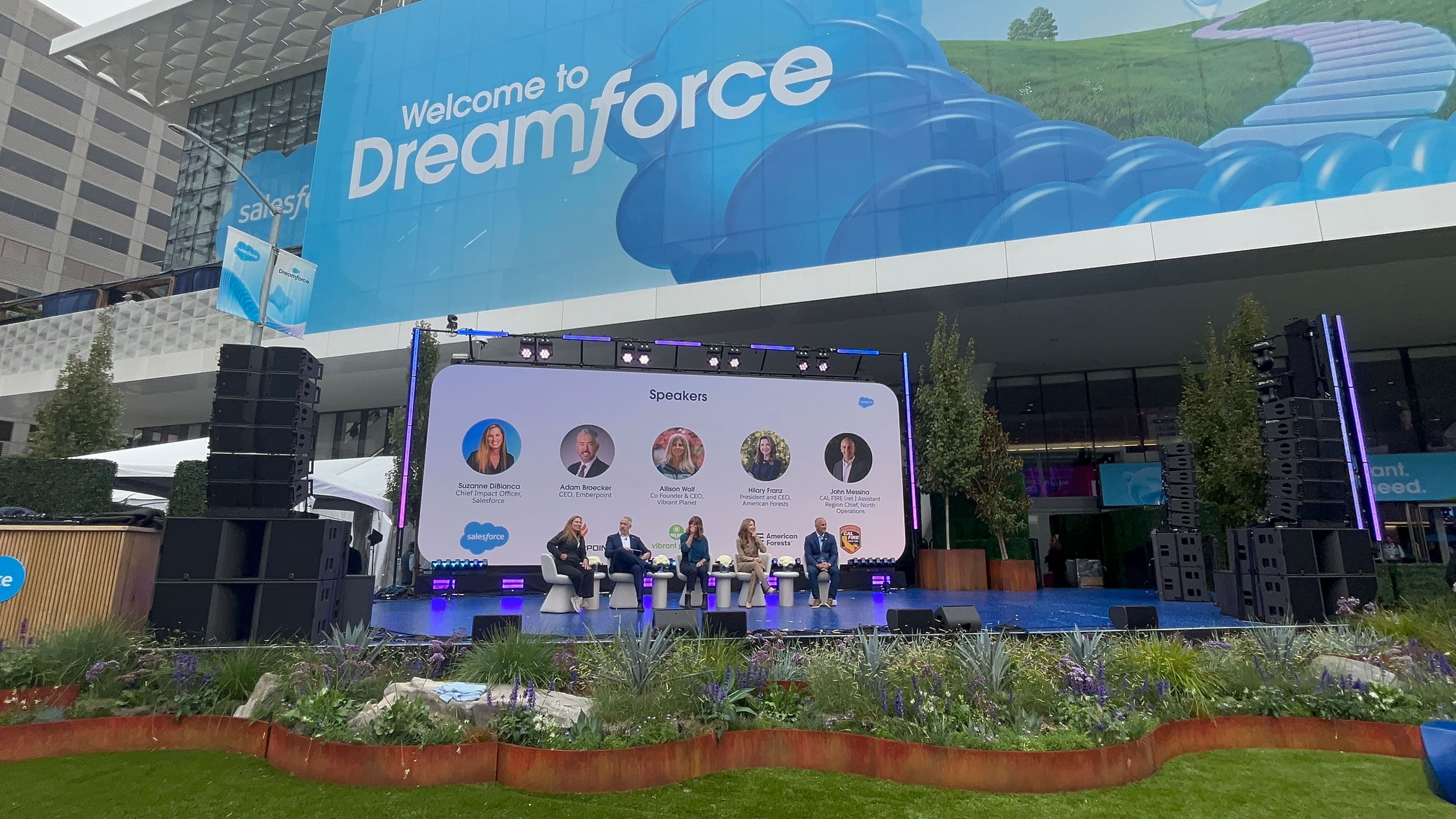
These are the numbers most people reach for when they talk about the wildfire crisis, and I've used them myself more times than I can count. But on September 16, standing on the Howard Street Stage at Dreamforce, I wanted to get past them, to the stories underneath: crews facing rapidly changing conditions with an incomplete picture, communities waiting for answers, and responders making consequential decisions under pressure most of us will never face.
What connects those moments is not simply a lack of technology. Many of the capabilities that can transform wildfire management — AI, autonomous systems, satellites, and aerial and ground technologies — already exist. The challenge is connecting them. When technologies and data remain disconnected, critical information can get lost and decisions can be delayed when every minute matters.
Why Dreamforce, why this room
The theme this year at Dreamforce was "the agentic enterprise," so most people in the audience don't spend their days thinking about wildfire. But they do spend their days thinking about something highly relevant to it: how to connect data, technology, and people into systems that can make better decisions at scale.
That may seem like an unexpected audience for a conversation about wildfire. To us, it made perfect sense. These are people who think deeply about integration, data, and trust — exactly the disciplines wildfire technology needs if we're going to move from fragmented solutions toward coordinated systems.
Inside "The First Hour"
I had the opportunity to speak on a panel, moderated by Salesforce's Suzanne DiBianca, alongside John Messina, CAL FIRE (ret.) Assistant Region Chief, North Operations, Vibrant Planet CEO Allison Wolff, and American Forests President and CEO Hilary Franz.
The panel focused on the first hour of a wildfire and the complex web of people, technology, and communities that must work together when every decision matters.
John grounded the discussion in the operational reality of that window, discussing what firefighters and incident commanders are trying to determine, where information breaks down, and why trust, simplicity, and speed matter more than novelty. Allison widened the lens, looking at why response can't be separated from mitigation and landscape planning. Hilary brought the national perspective, including the need for coordination across government, nonprofits, private companies, and communities.
When it was my turn, I came back to two questions we've been thinking about since we started building Emberpoint: How do you turn scattered signals into useful intelligence? And how do you build technology responders can actually trust under pressure?
The first problem has changed dramatically. Historically, detection and response relied on tools like spreadsheets and people visually spotting conditions from aircraft. Today, responders receive signals from data sources, incident reports, 911 calls, and technology-generated inputs.
The challenge has shifted from too little information to too much noise.
Emberpoint's role is to help reduce that noise, increase the signal, and use AI alongside rules-based approaches to turn scattered inputs into clearer, more usable intelligence for decision-making.
Turning wildfire data into trusted decision support
Trust is the harder half. Our firefighter-first mindset means we build with them from day one, rather than bringing them in after development, and we test with multiple organizations before live deployment. Wildfire response depends on teams coordinating in real time under enormous pressure. If technology doesn't support the experience of the people actually fighting fires, its sophistication doesn't matter.
Ultimately, AI will not put out a fire. Its role is decision support and coordination, helping firefighters get clearer information faster while keeping a firefighter-first mindset at the center of the system.
For us, that's the bigger point. AI can help turn more information into better intelligence, but it cannot operate in isolation. Its value comes from connecting with the technologies, data, and people already across the fire mitigation chain so responders can act on better information, faster.
That's our role at Emberpoint: serving as a mission integrator that brings AI, autonomy, and operations together to detect earlier, reduce spread, and fight wildfires smarter.
The future of wildfire response will rely on connected signals
Dreamforce reinforced how much appetite there is for that conversation and how far the coordination challenge extends beyond the fire service.
In the next piece, I'll share what we heard directly from the people who stopped by our booth, and what those conversations revealed about the broader need to connect technology, data, and decision-making across the wildfire ecosystem.
For now, the takeaway from my conversations at Dreamforce is simple: we already have many of the capabilities needed to change how we prepare for and respond to wildfire. AI can help connect those signals and support faster decisions, but its impact depends on the larger system around it.
The work ahead is making sure those capabilities work together.